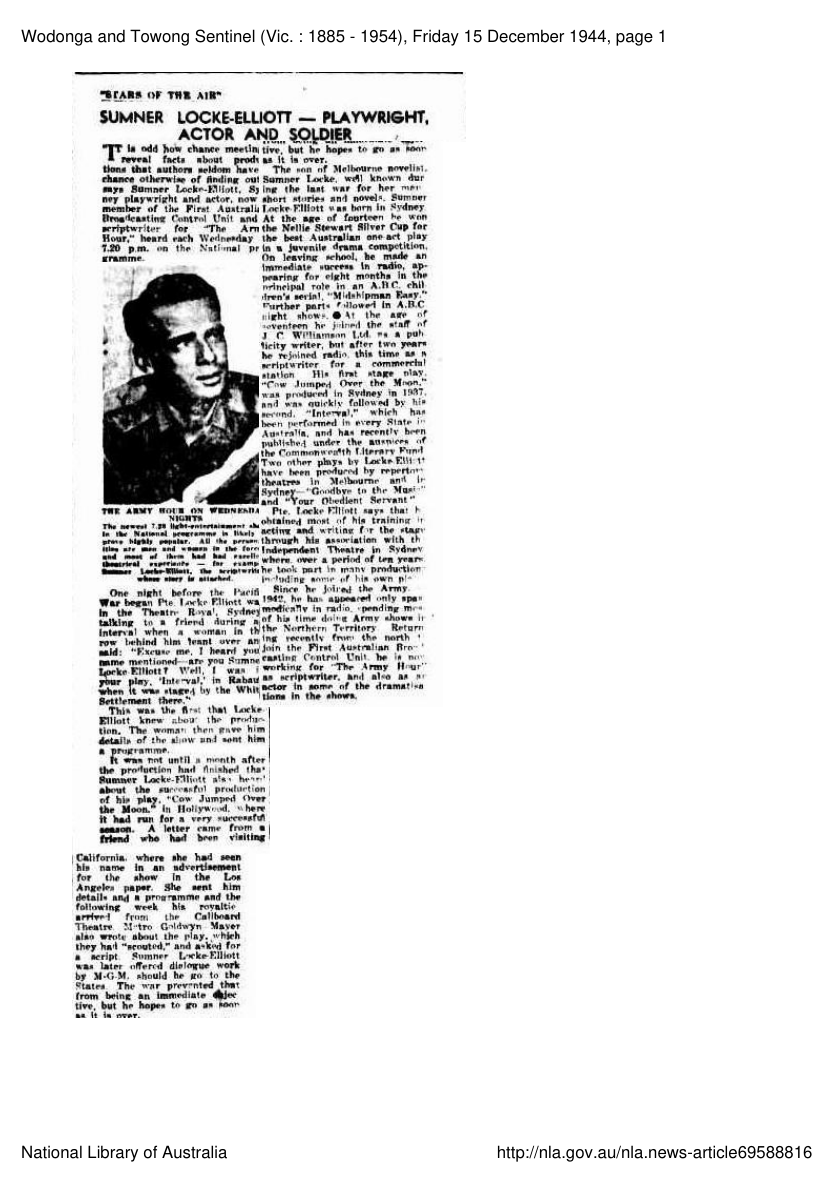
"STARS OF THE AIR"
SUMNER LOCKE-ELLIOTT — PLAYWRIGHT, ACTOR AND SOLDIER
The newest 7.20 light-entertainment show in the National programme is likely to prove highly popular. All the person-alities are men and women in the forces and most of them had had excellent theatrical experience — for example, Sumner Locke-Elliott, the scriptwriter, whose story is attached.
'TIS odd how chance meetings reveal facts about productions that authors seldom have chance otherwise of finding out says Sumner Locke-Elliott, Sydney playwright and actor, now member of the First Australian Broadcasting Control Unit and scriptwriter for "The Army Hour," heard each Wednesday at 7.20 p.m. on the National programme.
One night before the Pacific War began Pte. Locke Elliott was in the Theatre Royal, Sydney talking to a friend during an interval when a woman in the row behind him leant over and said: "Excuse me, I heard you name mentioned—are you Sumner Locke Elliott? Well, I was in your play, 'Interval,' in Rabaul when it was staged by the White Settlement there."
This was the first that Locke-Elliott knew about the production. The woman then gave him details of the show and sent him a programme.
It was not until a month after the production had finished that Sumner Locke-Elliott also heard about the successful production of his play, "Cow Jumped Over the Moon," in Hollywood, where it had run for a very successful season. A letter came from a friend who had been visiting California, where she had seen his name in an advertisement for the show in the Los Angeles paper. She sent him details and a programme and the following week his royalties arrived from the Callboard Theatre Metro-Goldwyn-Mayer also wrote about the play, which they had "scouted," and asked for a script. Sumner Locke-Elliott was later offered dialogue work by M-G-M, should he go to the States. The war prevented that from being an immediate objective, but he hopes to go as soon as it is over.
[Illegible Micro-text: approx 7 words] tive, but he hopes to go as soon as it is over.
The son of Melbourne novelist, Sumner Locke, well known during the last war for her many short stories and novels, Sumner Locke-Elliott was born in Sydney. At the age of fourteen he won the Nellie Stewart Silver Cup for the best Australian one-act play in a juvenile drama competition.
On leaving school, he made an immediate success in radio, appearing for eight months in the principal role in an A.B.C. children's serial, "Midshipman Easy." Further parts followed in A.B.C. night shows. At the age of seventeen he joined the staff of J C. Williamson Ltd. as a publicity writer, but after two years he rejoined radio, this time as a scriptwriter for a commercial station. His first stage play, "Cow Jumped Over the Moon," was produced in Sydney in 1937, and was quickly followed by his second, "Interval," which has been performed in every State in Australia, and has recently been published under the auspices of the Commonwealth Literary Fund Two other plays by Locke-Elliott have been produced by repertory theatres in Melbourne and in Sydney—"Goodbye to the Music" and "Your Obedient Servant."
Pte. Locke Elliott says that he obtained most of his training in acting and writing for the stage through his association with the Independent Theatre in Sydney, where, over a period of ten years, he took part in many productions including some of his own plays.
Since he joined the Army, in 1942, he has appeared only spasmodically in radio, spending most of his time doing Army shows in the Northern Territory. Returning recently from the north to join the First Australian Broadcasting Control Unit, he is now working for "The Army Hour" as scriptwriter, and also as an actor in some of the dramatisation in the shows.